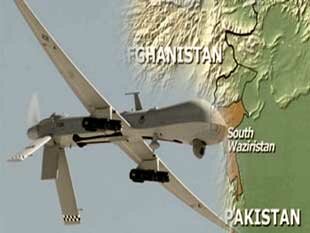
Drone missile attacks are increasingly becoming the weapon of choice of the U.S. Central Intelligence Agency.
by: Rick Rozoff Stop NATO March 9, 2010
2010 is the last year of the new century and millennium and is the tenth consecutive year of the United States' war in Afghanistan and in the 15-nation area of responsibility subsumed under Operation Enduring Freedom. In early March American military deaths in the Greater Afghan War theater -Afghanistan, Cuba (Guantanamo Bay), Djibouti, Eritrea, Jordan, Kenya, Kyrgyzstan, Pakistan, the Philippines, Seychelles, Sudan, Tajikistan, Turkey, Uzbekistan and Yemen - surpassed the 1,000 mark.
This year is also the tenth year of the first ground and the first Asian war fought by the North Atlantic Treaty Organization, which wages wars from and not to protect the nations of the northern Atlantic Ocean.
2010 is the tenth and deadliest year in Washington's use of unmanned aerial vehicles (drones) for targeted assassinations and untargeted "collateral damage."
Originally designed for battlefield surveillance and reconnaissance, albeit often to call in lethal military strikes, drones have been employed by the U.S. since 2001 to identify and kill human targets.
The first "hunter-killer" unmanned combat air vehicle, the Predator, was used by the Pentagon in Bosnia in 1995 and later in the 78-day air war against Yugoslavia in 1999.
In 2001 Predators were equipped with Hellfire missiles and were deployed from Pakistan and Uzbekistan to launch attacks inside Afghanistan. The following year they were flown from the U.S. military base at Camp Lemonnier in Djibouti for the same purpose in Yemen.
The Predator and its successor, the Reaper, capable of carrying fifteen times more weaponry and flying at three times the speed, have been used for deadly attacks in Afghanistan, Iraq, Yemen, Somalia and with particularly murderous effect in Pakistan since the autumn of 2008. They are equipped with cameras connected by satellite links to bases in the United States.
In October Vice Admiral Robert Moeller, deputy commander of U.S. Africa Command, announced that Reapers, "capable of carrying a dozen guided bombs and missiles," [1] were deployed to Seychelles off the eastern coast of the African continent to patrol the Indian Ocean.
Radio Australia ran a story on March 8 that stated "US President Barack Obama may have taken his time to decide on his Afghanistan policy, but he's also now become more of an enthusiast for drone missile strikes than his predecessor. " [2] In both Afghanistan and Pakistan as well as in Yemen.
Discussing a report by the New America Foundation, the station documented that deadly U.S. drone missile strikes on both sides of the Afghanistan- Pakistan border have been increased by 50 per cent since the Obama administration took over the White House a year ago January 20.
Citing the above-mentioned think tank, the Radio Australia report said there have been 64 drone strikes in South Asia in the past fourteen months compared to 45 under the George W. Bush administration between the invasion of Afghanistan in October of 2001 and January of 2009.
Bill Roggio, editor of the Long War Journal, was interviewed and said "there is an average five to seven strikes a month although in January there were 11."
He was further quoted describing the qualitative as well as the quantitative escalation of American drone warfare in Afghanistan and Pakistan: "The main drone is the 'Predator' which carries the 'Hellfire' anti-tank missile.
"The 'Reaper,' the older brother of the Predator, they made that so it could carry larger Hellfire missiles as well as it can carry, again, the 500 pound GPS (global position system)-guided bombs. So they're very, you know, this is sort of a revolution in air warfare." [3]
The Reaper carries a thousand pounds of munitions and is also equipped for the Sidewinder heat-seeking air-to-air missile. Plans for adding Stinger air-to-air missiles are underway.
In terms of the human cost of Obama's 2008 Afghan war campaign pledge - "If we have actionable intelligence about high-level al Qaeda targets in Pakistan's border region, we must act if Pakistan will not or cannot" - at the beginning of this year Pakistan's influential Dawn News published an account of what that policy has meant to Pakistanis. In an article titled "Over 700 killed in 44 drone strikes in 2009," the source, quoting Pakistani government statistics, wrote:
"Of the 44 predator strikes carried out by US drones in the tribal
areas of Pakistan over the past 12 months, only five were able to hit their
actual targets, killing five key Al-Qaeda and Taliban leaders, but at the cost of over 700 innocent civilians."
For each alleged al-Qaeda or Taliban member killed by missiles fired from U.S. drones "140 innocent Pakistanis also had to die. Over 90 per cent of those killed in the deadly missile strikes were civilians, claim authorities. ...On average, 58 civilians were killed in these attacks every month, 12 persons every week and almost two people every day." [4]
The dead may have been armed or unarmed, males or females, adults or children. What they have in common is that they were targeted based on "actionable intelligence" provided by someone on the ground, not necessarily a disinterested party.
Last October, as the killing had begun in earnest, UN Special Rapporteur on Extrajudicial Executions Philip Alston warned:
"My concern is that these drones, these Predators, are being operated in a framework which may well violate international humanitarian law and international human rights law.
"The onus is really on the government of the United States to reveal more about the ways in which it makes sure that arbitrary executions, extrajudicial executions, are not in fact being carried out through the use of these weapons." [5]
Undaunted, the U.S. substantially intensified the attacks.
This January China's Xinhua News Agency interviewed Pakistani political analyst Farrukh Saleem, who said that American drone missile attacks in Pakistan's Federally Administered Tribal Areas had increased from 17 in 2008 to 43 in 2009 with more than 70 expected to be delivered this year.
Saleem was quoted warning that "Such attacks always trigger violence, suicide attacks and casualties in Pakistan. So more drone attacks mean more violence in Pakistan." [6]
On the same day Senator John McCain was in the Pakistani capital of Islamabad and praised the drone attacks as "an effective part of the U.S. strategy." [7]
It was reported last December 17 that a U.S. drone strike had killed at least 20 people in Pakistan's North Waziristan Agency and on the 27th that 13 more were killed in the same region.
Since the New Year began the lethal attacks have only intensified. The following is not an attempt at a comprehensive account, but is gathered from assorted press reports.
On January 1 it was reported that five people were killed and several more injured by two American drone attacks east of the North Waziristan capital. As to the identities of the slain, Reuters quoted a local security official as saying, "The bodies were burned beyond recognition. We are trying to determine their identity." [8] The previous night two more were killed and several injured in another strike.
Reports continued to detail missile strikes and deaths in the nation's tribal areas.
January 3: Five more people were killed in North Waziristan in a drone attack.
January 6: At least thirteen were killed and eight wounded by two back-to-back missile strikes. "According to Pakistan's Geo News, a suspected drone fired two missiles at a house in the Datta Khel region in the first attack, killing seven people.
"Another strike occurred as local people began retrieving bodies from the rubble of the house, killing five people. The identities of those killed in the attacks were unknown." [9]
January 8: Five were killed in a village in North Waziristan.
January 9: An American drone fired two missiles into a village, Ismail Khan, in North Waziristan which killed four people.
January 13: Thirteen people were killed in the village of Tappi in the same agency. "A senior security official confirmed the death toll, and said four missiles were fired from unmanned planes in the remote area." [10]
January 15: Fifteen were killed in the village of Zannini in North Waziristan. Six were killed in the village of Bichi.
January 17: At least twenty were killed in the Shaktoi area of South Waziristan.
January 19: Six people were killed in the village of Booya in North Waziristan according to Pakistani intelligence officials.
January 24: Pakistani insurgents claimed to have shot down a U.S. drone in North Waziristan, one of eight drones seen flying over the area.
January 29: Between six and fifteen people were killed in the North Waziristan town of Muhammad Khel in a reported attack on the Haqquani Network by three American missiles.
February 2: The U.S. fired as many as eight missiles into four villages in North Waziristan, killing twenty nine people.
February 14: Five people were killed in a drone attack in the same agency. At least three others were wounded.
February 15: A drone strike allegedly killed a Chinese Uighur separatist leader in the same district.
February 17: A U.S. missile strike killed three and injured two victims in North Waziristan.
February 18: Four people were killed in a missile strike on a vehicle in the same agency.
February 24: At least thirteen alleged militants were killed in a U.S. drone attack in the Dargah Mandi area of North Waziristan.
March 8: An American drone fired five missiles into a house near Miranshah, the capital of North Waziristan, killing at least five people and wounding four.
Approximately 160 people have been killed in drone missile strikes in Pakistan in slightly over two months this year. If that pace continues, 2010 will be far deadlier than the year before: 960 to 700. If, as seems more likely, the amount of the attacks increases, the death toll will be even higher than the nearly 140 per cent increase the above extrapolation threatens.
Drone missile attacks are increasingly becoming the weapon of choice of the U.S. Central Intelligence Agency (as in Pakistan, Afghanistan and Iraq), the Joint Special Operations Command (Yemen) and the Air Force, which as of last year had 195 Predators and 28 Reapers.
All indications are that they will soon have more.
This year the Obama administration has sought from Congress $33 billion more for the wars in Afghanistan and Iraq "on top of a record request for $708 billion for the Defense Department next year." [11]
With the new Quadrennial Defense Review, "The pilotless drones used for
surveillance and attack missions in Afghanistan and Pakistan are a priority, with a goal of speeding up the purchase of new Reaper drones and expansion of Predator and Reaper drone flights through 2013." [12]
A February 1 article called "China, Iran Prompt U.S. Air-Sea Battle Plan in Strategy Review," revealed that in line with the new Quadrennial Defense Review a "joint Air Force-Navy plan would combine the strengths of each service to conduct long-range strikes that could utilize a new generation of bombers, a new cruise missile and drones launched from aircraft carriers." [13]
As the U.S. is massively expanding its military buildup on the Pacific island of Guam, "The Army is building a missile defense system on the island and the Air Force is adding more drones." [14]
In mid-January prominent U.S. senator Carl Levin called for "using drones to launch airstrikes" in Yemen, adding the demand for "everything from physical actions that could be accomplished in terms of use of drones or air attacks" to "clandestine actions." [15]
Regarding the strengthening of military ties between the U.S. and Yemen, a Russian news source disclosed that "Under a new classified cooperation agreement, the U.S. would be able to fly cruise missiles, fighter jets or unmanned armed drones against targets in the country, but would remain publicly silent on its role in the airstrikes." [16]
In late January the Wall Street Journal reported:
"The U.S. military's involvement in Yemen has already begun to grow....[T]he U.S. has increased the number of surveillance drones flying over Yemen, as well as the number of unmanned aircraft outfitted with missiles capable of striking targets on the ground, according to a senior U.S. official with direct knowledge of the deployments.
"Most drones operating outside of Iraq and Afghanistan are controlled by the Central Intelligence Agency, but the official said the drones operating over Yemen belong to the military's secretive Joint Special Operations Command." [17]
The commander of Joint Special Operations Command until 2008 was now General Stanley McChrystal, military chief of what will soon be 150,000 U.S. and NATO troops in Afghanistan.
Drone missile assassinations and the indiscriminate slaughter of civilians that often accompany them are an integral component of his counterinsurgency strategy in South Asia. The qualitative escalation of drone attacks in Pakistan and Afghanistan began when McChrystal replaced David McKiernan as top U.S. and NATO-led International Security Assistance Force commander in Afghanistan last June.
In other parts of the world, the Pentagon is to contribute military drones for the Northern Coasts maneuvers in Finland this September, the "largest naval military exercise that has ever been seen in Finnish territorial waters." [18]
A resolution issued by the Finnish Peacefighters in Lapland last month mentioned "a program on Finnish TV about Unmanned Aerial Vehicles being tested in Lapland at the Kemijarvi Airfield. This actual training area stretches to the Russian border and follows the border for tens of kilometers.
"The strategy for Star Wars, which the US is developing, means that the pilotless plane is directed from a command center in Nevada, and follows the terrain and movements on a data screen thousands of kilometers away and maneuvers the drones. These drones have been used in Afghanistan and they have killed a lot of civilians." [19]
While Stanley McChrystal was commander of the Joint Special Operations Command the U.S. conducted eleven deadly predator attacks in Iraq in April of 2008. At the time "Defense Secretary Robert Gates prodded the Air Force to do more to rush drones to the war zone."
An American newspaper reported at the time that "Commanders are expected to rely more on unmanned systems as 30,000 U.S. troops sent last year are withdrawn. The military has dozens of Predators in Iraq and Afghanistan. In all it operates 5,000 drones, 25 times more than it had in 2001." [20]
Last December the government of Venezuela called on the world community to condemn incursions into its airspace by U.S. military drones operating from Aruba and from Curacao in the Netherlands Antilles. The type of drones that flew for several days over Venezuelan territory wasn't specified, but under both bilateral and NATO military obligations the Netherlands would not refuse the U.S. the right to station Predator and Reaper drones on bases in their Caribbean island colonies.
The United States has not only increased its arsenal of unmanned aerial vehicles by twenty five times over the past decade, it has massively increased the range and lethality of its hunter-killer drones. A recent report disclosed that beginning in 2008 the Air Force Research Laboratory started to "build the ultimate assassination robot," described as "a tiny, armed drone for U.S. special forces to employ in terminating 'high-value targets.'” [21]
Formerly special forces teams were deployed or cruise missiles were fired to assassinate intended victims. In the case of the second and frequently the first the risk was that they couldn't be used twice.
Predator and Reaper drones return after missions and their supply of Hellfire missiles is replenished for further deadly attacks.
They have become Washington's preferred 21st century weapons for perpetrating international assassinations.
1) Associated Press, October 25, 2009
2) Radio Australia, March 8, 2010
3) Ibid
4) Dawn News, January 2, 2010
5) BBC News, October 28, 2009
6) Xinhua News Agency, January 8, 2010
7) Ibid
8) Reuters, January 1, 2010
9) ADN Kronos International, January 6, 2010
10) Agence France-Presse, January 14, 2010
11) Associated Press, January 12, 2010
12) Ibid
13) Bloomberg News, February 1, 2010
14) Voice of America News, January 19, 2010
15) Press TV, January 13, 2010
16) Russian Information Agency Novosti, December 30, 2009
17) Wall Street Journal, January 27, 2010
18) Helsingin Sanomat, January 28, 2010
19) http://groups. yahoo.com/ group/stopnato/ message/44296
20) USA Today, April 29, 2008
21) Wired, January 5, 2010